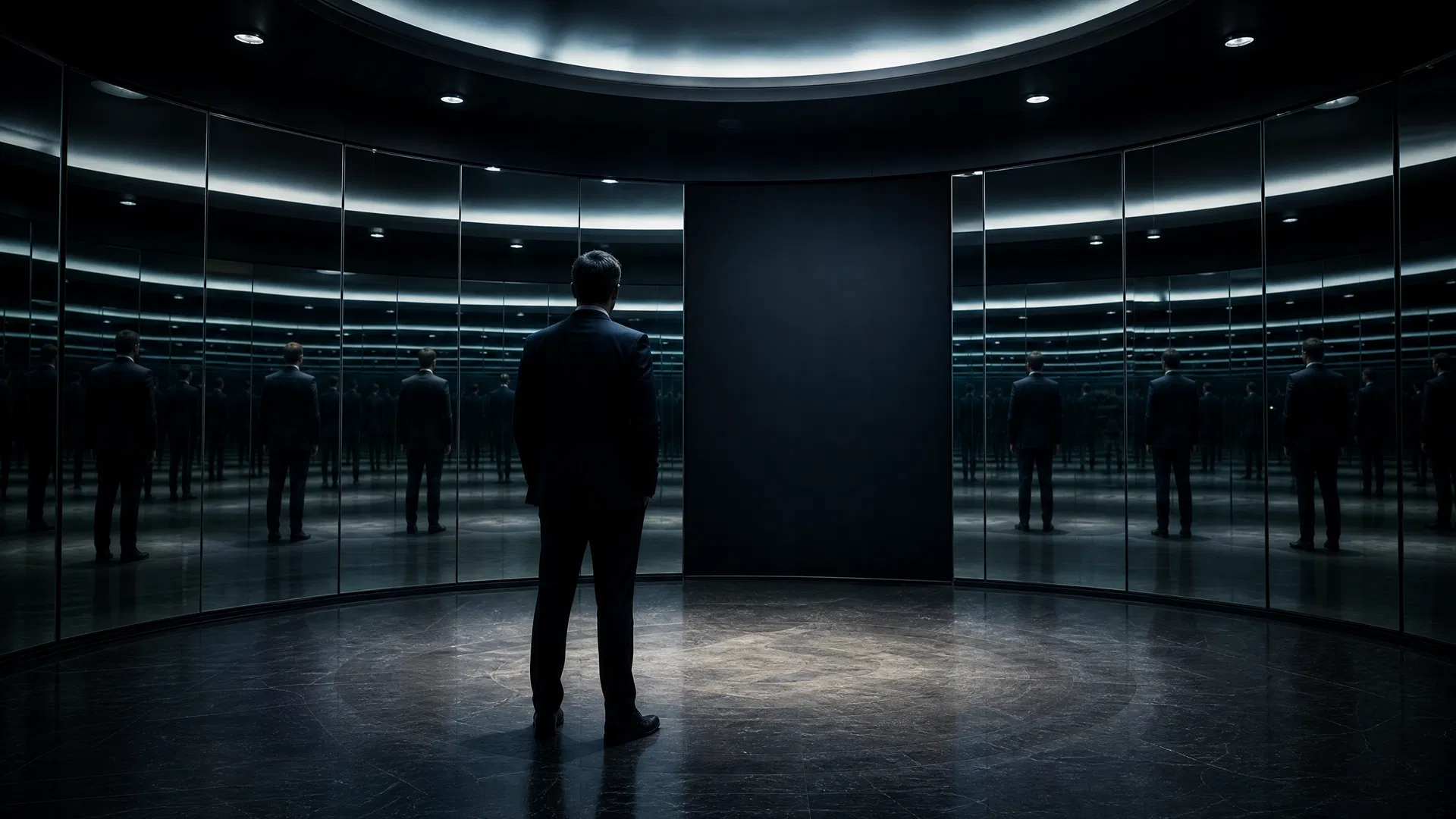
blind spot
The Blind Spot You Cannot See
There is a specific type of error that appears consistently in senior leadership transitions, and it is not the type that gets discussed in the conventional literature. It is not a capability gap. It is not a knowledge deficit. It is not a failure of preparation or effort or intent. It is the error that occurs when an executive applies a sound framework correctly — and still misses the thing that matters most.
The error is structural. It is built into the conditions of the transition itself. And the reason it is so rarely addressed is that the person experiencing it cannot see it from the inside.
The Closed Loop Problem
When a senior executive enters a new role, they bring with them a set of frameworks, mental models, and interpretive lenses built from years of experience. Those frameworks are genuinely useful. They allow the executive to process information quickly, identify patterns, and make decisions under uncertainty. Without them, the cognitive load of a new environment would be unmanageable.
But those same frameworks create a closed loop. The executive interprets what they observe through the lens of what they already know. The patterns they identify are the patterns their existing frameworks are designed to detect. The signals they notice are the signals their experience has taught them to look for. And the signals their frameworks are not designed to detect — the ones that indicate something genuinely new, or something that contradicts the executive's existing model — are systematically filtered out before they reach conscious attention.
This is not a failure of intelligence. It is how cognition works. The brain does not process raw experience. It processes experience through interpretive filters built from prior learning. The filters are efficient precisely because they are selective. But in a new environment, the selectivity that makes the filters efficient is also what makes them dangerous.
The specific danger in a senior leadership transition is this: the executive's commitment to a particular reading of the situation — a particular interpretation of a stakeholder's behaviour, a particular diagnosis of an organisational dynamic, a particular assessment of their own performance — becomes the filter through which all subsequent information is processed. Evidence that confirms the interpretation is noticed and weighted. Evidence that contradicts it is noticed less, or not at all, or is reinterpreted to fit.
This is the closed loop. And the executive operating inside it cannot see it, because the same cognitive architecture that creates the loop also prevents the executive from observing the loop from outside it.
What the Closed Loop Looks Like in Practice
The most common manifestation is a conviction that has solidified too early. An executive forms a view — about a direct report, about a stakeholder, about the organisation's readiness for change — within the first few weeks of a transition. The view feels well-founded. It is based on direct observation. It is consistent with the executive's experience in previous roles. And it is wrong in a way that will not become visible until the cost of the error has already been incurred.
The Sarah scenario illustrates this precisely. An executive, sixty-odd days into a new role, forms a clear view that a direct report is not performing at the required level. The certainty feels complete. The decision crystallises. Eleven weeks later, reviewing the quarter's results, it becomes clear the assessment was wrong. The direct report had not been defensive. She had been precise. The data she was presenting was accurate. The pattern the executive thought they were seeing was not there.
What happened between the initial assessment and the later recognition? Nothing, in terms of new information. The executive did not gather additional intelligence that changed the picture. The picture changed because the cognitive conditions changed — the acute phase of the transition had passed, the cortisol load had reduced, and the interpretive filter that had been operating with particular force in week seven was no longer distorting the signal in the same way.
The executive had been inside the closed loop. The loop had produced a confident, well-reasoned, completely wrong conclusion. And there was no mechanism, operating from inside the loop, that could have detected the distortion in real time.
The Structural Limitation of Self-Administered Frameworks
This is the point at which the conventional advice — "apply the framework," "use the structured approach," "follow the 90-day plan" — reaches its limit.
The frameworks are genuinely useful. The structured approaches are genuinely better than the unstructured ones. The executive who applies a systematic approach to stakeholder mapping, decision-making, and performance assessment will navigate the transition more effectively than one who does not. This is not in dispute.
But there is a specific function that no self-administered framework can reliably perform: the detection of fundamental misalignment between the executive's interpretation of the situation and what is actually happening — early enough for the misalignment to be addressed before the irreversible decisions arrive.
The reason is structural. The framework is being applied by the same cognitive system that is generating the misalignment. The executive who is inside the closed loop cannot use the framework to detect the loop, because the framework is being run through the same interpretive filter that is creating the problem. It is like asking someone to proofread their own writing for errors they cannot see. The proofreading process uses the same pattern-matching system that produced the errors in the first place. The errors that are invisible to the writer remain invisible to the proofreader, because they are the same person.
An external observer does not have this problem. Not because they are smarter, or more experienced, or have access to better information. But because they are outside the closed loop. They can observe the gap between the executive's interpretation and the organisational response without the interpretive filter of the executive's commitment. They can see what the executive cannot see — not because of superior capability, but because of structural position.
The Three Things an External Observer Can Do That You Cannot
The first is to detect the gap between commitment and reception. An executive who has committed to a particular reading of a stakeholder relationship — "this person is resistant but manageable" — will interpret subsequent interactions through that lens. An external observer, without that commitment, will notice when the pattern of responses does not fit the interpretation. The executive will explain away the discrepancy. The external observer will flag it.
The second is to identify the signals the executive's framework is not designed to detect. Every framework has a detection range — the set of patterns it is designed to identify. The patterns outside that range are invisible to the framework. An external observer with a different set of frameworks, or with the specific function of looking for what the executive's frameworks are missing, can extend the detection range in ways the executive cannot extend it alone.
The third is to provide the specific kind of challenge that produces genuine reconsideration rather than defensive consolidation. When an executive's interpretation is challenged by someone inside the organisation — a direct report, a peer, even a board member — the challenge is processed through the political filter of the relationship. The executive weighs the challenge against the challenger's interests, their own authority, the organisational dynamics. The challenge may produce reconsideration, but it is as likely to produce consolidation — a more entrenched version of the original position, now defended against the specific challenge that was raised.
An external observer who has no stake in the organisational dynamics, and whose challenge is therefore not filtered through the political lens, produces a different kind of reconsideration. The executive can engage with the substance of the challenge without simultaneously managing the relationship implications of being challenged.
The Metacognitive Paradox
There is a deeper layer to this problem that is worth naming directly, because it is the layer that makes the closed loop genuinely difficult to address.
The cognitive function responsible for accurate self-assessment — metacognition, the capacity to observe one's own thinking — is specifically impaired under the conditions of a senior leadership transition. The sustained cortisol load of a new role reduces prefrontal cortex function. The prefrontal cortex is the seat of metacognitive accuracy. The executive who is most in need of accurate self-assessment is operating with the most impaired capacity for it.
This is not a paradox in the philosophical sense. It is a documented neurological reality. The research on metacognitive accuracy under stress is consistent: people are less accurate in their assessment of their own performance, their own reasoning, and their own cognitive state precisely when those assessments matter most. The executive who feels most confident in their judgement during the acute phase of a transition is not necessarily the one whose judgement is most reliable. They may be the one whose metacognitive warning system is most comprehensively suppressed.
The practical implication is that the executive cannot rely on their own sense of whether their judgement is compromised as a reliable indicator of whether their judgement is compromised. The warning system and the performance system are impaired by the same mechanism. The executive who is inside the closed loop does not feel like they are inside a closed loop. They feel like they are thinking clearly.
What This Is Not Saying
This is not an argument that senior executives cannot navigate transitions without external support. Many do. The framework is partially usable without external expertise, and the executive who applies it systematically will navigate more effectively than one who does not.
What it is saying is more specific: the particular failure mode that the framework cannot reliably prevent without external observation — late detection of fundamental misalignment, after the irreversible decisions have already been made — is precisely the failure mode that is most costly to experience.
An executive can choose to work without external support. That is a legitimate choice. But it should be made with clarity about what is being chosen — and what the cost of that choice is likely to be, given the structural properties of the closed loop.
The question is not whether you have the capability to navigate the transition. You do. The question is whether you have the structural position to detect the specific errors that capability alone cannot prevent.
The Function That Changes the Outcome
The TransitionReady assessment is designed to do one specific thing: map the particular configuration of the closed loop in the executive's specific transition — the specific interpretive filters that are operating, the specific signals that are being missed, the specific misalignments between the executive's reading of the situation and the organisational response.
It does not tell the executive what to think. It does not replace the executive's judgement. It extends the detection range of the executive's own framework into the territory that the framework, applied alone, cannot reach.
The framework applies universally. The closed loop is a structural feature of every senior leadership transition, not a personal failing. What varies is the specific configuration — the particular commitments that are generating the filter, the specific signals that are being missed, the precise point at which the misalignment is occurring.
That configuration is what requires individual intelligence-gathering. And that intelligence-gathering is what the assessment is designed to provide.